USB AOC Cables

  • USB AOC AM to AM Cables
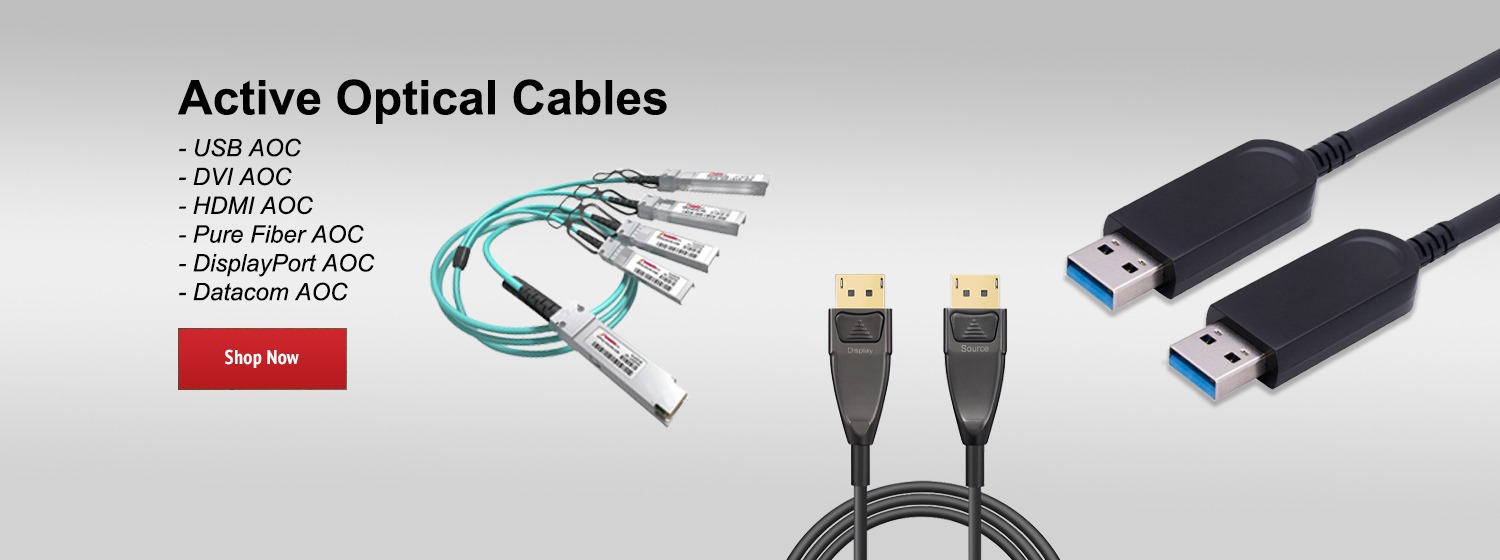
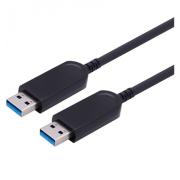
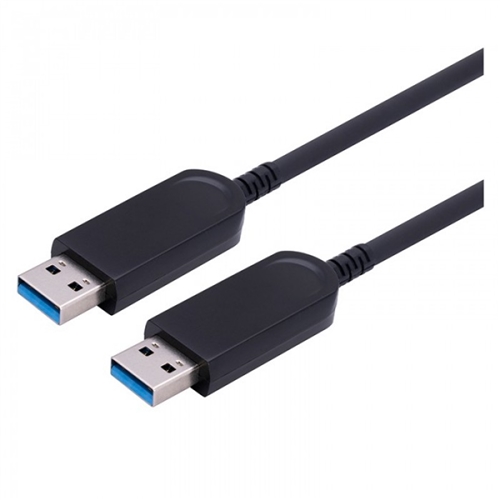
    A USB AOC AM to AM cable is an Active Optical Cable (AOC) with a USB Type-A Male connector on both ends. These cables utilize fiber optics for data transmission, allowing for longer cable lengths and faster speeds compared to traditional copper USB cables. 

    Here's a breakdown of what this means:

    AOC (Active Optical Cable):

    • AOCs use optical fiber to transmit data, converting electrical signals to light at one end and back to electrical signals at the other end.
    • This allows for higher bandwidth and longer distances than copper cables without signal loss or degradation. 

    USB Type-A Male:

    • This is the standard, rectangular USB connector commonly found on computers and other host devices.
    • "AM" indicates that the connector on both ends is a Type-A Male. 

    In essence, a USB AOC AM to AM cable provides a high-speed, long-distance USB connection using optical fiber technology, with a standard USB Type-A male connector on each end. 

    Key Features & Benefits:

    • High Bandwidth: Supports USB 3.0 and USB 3.1 standards, allowing for high data transfer rates (e.g., 5 Gbps for USB 3.0 and 10 Gbps for USB 3.1 Gen 2).
    • Long Distance: Can extend USB connections much farther than traditional copper cables, often up to 100 meters or more, depending on the specific cable and USB standard.
    • Low Signal Loss: Fiber optic transmission minimizes signal degradation over long distances, ensuring reliable data transfer.
    • EMI/RFI Resistance: Offers better resistance to electromagnetic and radio frequency interference compared to copper cables. 

    Applications:

    • Industrial and Machine Vision: Connecting cameras, sensors, and other devices over long distances in industrial settings.
    • Medical Imaging: Transmitting high-resolution medical images and data.
    • Conference Rooms and Auditoriums: Connecting USB devices like cameras and touchscreens in larger spaces.
    • Remote Desktop USB 3.0 Connections: Extending USB connections to remote workstations.
    • Security and Surveillance: Connecting security cameras and other monitoring equipment.
    • AR/VR: Connecting VR headsets and other peripherals requiring high bandwidth and low latency. 

    Important Considerations:

    • Power Delivery: Pure fiber USB AOCs typically do not transmit power, so devices connected through them may require separate power sources. Hybrid AOCs incorporate copper wires for power delivery in addition to fiber for data.
    • Cost: AOCs are generally more expensive than standard copper USB cables.
    • Compatibility: Ensure compatibility with the specific USB standard and connector type of the devices you intend to connect.

    USB 3.1 Gen 2 Type-A Male to Type-A Male 10G Hybrid Active Optical Cable, Backward Compatible.

    The AOC-U31-AM-AM USB 3.1 A male to A male AOC is a 10Gbps USB 3.1 GEN 2 active optical cable which is downward compatible with USB 2.0. It is designed for PC USB to peripheral devices with superior performance while providing a reliable plug-and-play user experience. It supports length up to 15m. Its suitable for applications that do not have on-site power supply. This optical fiber cable can be applied to machine vision, Remote monitoring, etc.
     
    Features
    • Meet USB 3.1 GEN 2 Standard , bandwidth can reach to 10Gbps super speed
    • Support length up to 15m
    • Support 5V 900mA max
    • Support two sides plug and play on type C connector
    • Support downward compatible with USB2.0/1.1
    • No RF interference , working stable in complex environments
     
    Specifications
    • Maximum length: 15m
    • Connector
      • Type: A (male) / A (male)
      • Contacts: Gold plated, long-life design
    • Wire
      • Cable diameter: 4.85 mm
      • Bend radius: 40 mm static / 80 mm dynamic
      • Jacket: PVC
    • Mechanical
      • Supply voltage: 4.75 – 5.25 V
      • Power consumption: < 0.50 W (both sides)
      • Operating conditions: -20°C ~ 70°C, 0%-85% humidity
    • Safety
      • Device: CE
      • EMI / EMC: FCC Class B, CISPR 32

    USB Connector Type Reference Chart

    USB 2.0 Type A
    USB 3.0 Type A
    USB 3.1 Type A
    USB Connector Type Reference Chart | Compufox.com
    USB 2.0 Type C
    USB 3.0 Type C
    USB 3.1 Type C
    USB Connector Type Reference Chart | Compufox.com
    USB 2.0 Type B

    USB Connector Type Reference Chart | Compufox.com
    USB 3.0 Type B

    USB Connector Type Reference Chart | Compufox.com
    USB 2.0 Micro B

    USB Connector Type Reference Chart | Compufox.com
    USB 3.0 Micro B

    USB Connector Type Reference Chart | Compufox.com
    USB 2.0 Mini B
    USB 3.0 Mini B

    USB Connector Type Reference Chart | Compufox.com


    Read more
  • USB AOC AM to Micro-B Cables


    USB 3.0 AM to Mirco B Active Optical Cable – compufox.com

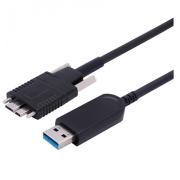
    A USB AOC AM to Micro-B cable is a specialized type of USB cable that utilizes active optical cable (AOC) technology to extend the reach of USB connections beyond the typical limitations of copper cables.

    Here's a breakdown of its key features and applications:

    1. What it is:

    AOC (Active Optical Cable): AOCs combine copper wires for power delivery and optical fibers for data transmission.

    USB AM (Type-A Male): The standard, rectangular USB connector commonly found on computers and laptops.

    Micro-B: A smaller USB connector often used for peripherals like older Android phones, external hard drives, and some cameras.

    2. How it works:

    The USB Type-A end connects to a host device (e.g., computer), while the Micro-B end connects to a peripheral.

    The cable converts the electrical USB data signal into optical signals, which are transmitted through the fiber optic core.

    At the receiving end, the optical signals are converted back into electrical signals for the device to use.

    Copper wires within the cable provide power to the active components and the connected device.

    3. Advantages:

    Longer distances: AOC technology allows for significantly longer cable lengths (e.g., 10 meters or more) compared to standard copper USB cables, which are typically limited to a few meters.

    High bandwidth: Supports USB 3.0/3.1/3.2 speeds for fast data transfer.

    Reduced EMI/RFI: Fiber optic cables are immune to electromagnetic interference, making them suitable for environments with high electrical noise.

    Thin and flexible: Despite the advanced technology, AOC cables are often thinner and more flexible than traditional copper cables, making them easier to manage.

    4. Applications:

    Industrial Machine Vision: Connecting high-resolution cameras to computers over long distances for image processing.

    Medical Imaging: Connecting medical devices and cameras to workstations.

    Remote Device Connections: Extending the reach of USB peripherals like external hard drives, scanners, and printers.

    Conference Rooms & Digital Signage: Connecting displays, webcams, and other devices over extended distances.

    5. Considerations:

    Cost: AOC cables are typically more expensive than standard copper USB cables due to the advanced technology involved.

    Power Delivery: While AOC cables can deliver power to devices, the amount of power may be limited, especially over longer distances.

    Compatibility: Ensure the AOC cable is compatible with the USB version and speed requirements of your devices.

    In summary, a USB AOC AM to Micro-B cable offers a high-performance solution for extending USB connections over longer distances, especially in applications where high bandwidth, low interference, and flexibility are crucial.


    USB 3.1 Gen 2 Type-A Male to Micro-B Male 10G Hybrid Active Optical Cable, Backward Compatible.


    The Hybrid AOC cabling technology uses copper wires and optical fibers to join the electrical connectors on each end of the cable. The result is improved speed and bandwidth transmission distances with a thinner cable that is flexible and lightweight. This AOC-U31-AM-MB USB 3.1 Gen 2 AM-BM AOC cables are designed for PC USB to peripheral devices with superior performance while providing a reliable plug-and-play user experience.
     
    Features
    • USB 3.1 Gen 2 and full bandwidth of 10Gbps
    • Variety of pre-assembled cable lengths available, up to 15m
    • Support 5V 900mA max
    • Patented AOC hybrid-cable with only 5 mm bend radius
    • Supports both USB 2.0 and 3.1 in same cable up 50 meters
    • For data transfers of up to 10G, no charging or powering of devices
    • EMI (electromagnetic interference) protection
     
    Specifications
    • Maximum length: 15m
    • Connectors
      • Type: Type-A (male) to Micro-B (male)
      • Contacts: Gold plated, long-life design
    • Wire
      • Cable diameter: 4.85 mm
      • Bend radius: 40 mm static / 80 mm dynamic
      • Jacket: PVC, CMR / CMP, CPR Eca
    • Mechanical
      • Supply voltage: 4.75 – 5.25 V
      • Power consumption: < 1 W (both sides)
      • Operating conditions: -20°C ~ 70°C, 0%-85% humidity
    • Safety
    • Device: CE, FCC
    • EMI / EMC: CISPR 32
     
     
    Read more
  • USB AOC Cables

    USB Active Optical Cables (AOCs) are a specialized type of USB cable that utilizes optical fiber to transmit data, offering significant advantages over traditional copper USB cables, especially for long-distance connections.

    Here's a breakdown of USB AOC cables:

    1. How They Work:

    • Hybrid Design: USB AOCs combine optical fiber for data transmission with copper wires to provide power to the connected device and the active electronics within the cable.
    • Signal Conversion: The cable incorporates tiny transceivers at each end that convert electrical USB signals into optical signals for transmission over the fiber, and then back to electrical signals at the receiving end. 

    2. Advantages of USB AOC Cables:

    • Longer Distances: AOCs can transmit data over significantly longer distances than copper USB cables without signal degradation. They can reach lengths of 10 meters (33 feet) and beyond, whereas standard copper cables have a limited range, typically around 2 meters (6.5 feet) for USB-C.
    • High Data Speeds: AOCs can support high-bandwidth data transmission, making them ideal for applications like high-resolution video (e.g., 4K, 8K), fast data transfers, and demanding peripherals.
    • Reduced Interference: Fiber optic cables are immune to electromagnetic interference (EMI), which can disrupt data transmission in copper cables, especially over long distances. This makes AOCs suitable for use in electrically noisy environments.
    • Improved Durability and Flexibility: AOCs are often thinner and more flexible than comparable copper cables and can be more resistant to bending or twisting damage. 

    3. Disadvantages of USB AOC Cables:

    • Higher Cost: AOCs are generally more expensive than standard copper USB cables due to the specialized components and manufacturing processes involved.
    • Directionality: Some AOCs may be directional, meaning they need to be plugged in with the correct end connected to the source and the device. 

    4. Applications of USB AOC Cables:

    • High-Performance AV Setups: Connecting 4K or 8K cameras, displays, and other devices over long distances.
    • Data Centers: Connecting servers and storage devices.
    • Industrial and Medical Imaging: Extending the reach of USB cameras for industrial inspection and medical imaging.
    • Surveillance and Security Systems: Connecting remote USB cameras for surveillance applications.
    • Virtual Reality: Providing high-bandwidth connections for VR headsets. 

    5. Types of USB AOC Cables:

    • USB 3.2 Gen 2: Supports data transfer speeds up to 10 Gbps.
    • USB4: The latest generation of USB, supporting higher data transfer speeds.
    • Different Connector Types: Available with various USB connector types, including USB-A, USB-B, USB-C, Micro-B, and Mini-B, to suit different devices and applications. 

    In summary, USB AOC cables are a valuable solution for applications requiring high-speed data transmission over long distances and in environments prone to electromagnetic interference. While they are more expensive than traditional copper cables, their performance advantages make them a worthwhile investment in demanding professional settings. 

    Buy USB AOC Cables at compufox.com

     USB AOC AM to AM
     USB AOC AM to AF
     USB AOC AM to BM
     USB AOC AM to Micro-B
     USB AOC AM to Type-C
     USB AOC Type C-C
     USB HUB for USB AOC


    Read more

Latest Articles

  • NVIDIA® ConnectX NIC Series Overview and Comparison
    NVIDIA® ConnectX NIC Series Overview and Comparison
    In today's data-driven world, high-performance networking is essential for powering the most demanding applications. As...
  • SAS Cables
    SAS Cables
    SAS stands for Serial-attached SCSI. SAS cables are used to connect devices such as hard disk drives (HDDs), solid-state drives...
  • Intel Network Adapters
    Intel Network Adapters
    Intel manufactures a wide range of network adapters, both wired (Ethernet) and wireless (Wi-Fi and Bluetooth), for various...
  • USB AOC AM to AM Cables
    USB AOC AM to AM Cables
    A USB AOC AM to AM cable is anActive Optical Cable(AOC) with a USB Type-A Male connector on both ends. These cables utilize...
  • USB AOC AM to Micro-B Cables
    USB AOC AM to Micro-B Cables
    USB 3.0 AM to Mirco B Active Optical Cable – compufox.com A USB AOC AM to Micro-B cable is a specialized type of USB...

Most Popular