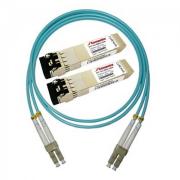
SAS Cables

SAS stands for Serial-attached SCSI. SAS cables are used to connect devices such as hard disk drives (HDDs), solid-state drives (SSDs), and CD-ROM drives in a serial point-to-point interface. It's an evolution of the traditional parallel SCSI interface.
Key features of SAS cables:
- Serial Communication: Data is transferred serially, rather than in parallel.
- Differential Signaling: They use a set of four wires as two differential signal pairs for faster and more reliable data transfer.
- Full-Duplex: Data can be transmitted in both directions simultaneously.
- Ports and Physical Links: SAS physical links are grouped into ports.
- Wide Ports: Contain multiple SAS physical links, enhancing performance and providing redundancy.
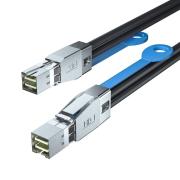
- Connectors: Two main types of SAS connectors exist:
- Mini SAS
- Mini SAS HD (High Density) High-density cables are generally needed for faster speeds like 6 Gb/s SAS.
Speed and Performance:
- SAS offers higher data transfer rates compared to SATA.
- SAS-3 can achieve speeds up to 12 Gb/s, with newer versions supporting even higher speeds.
- SAS-4 is available with speeds up to 24 Gbps.
- The full-duplex transmission supports up to 12.0 Gbps.
- Mini-SAS HD SFF-8644 cables can provide 48 Gb/s bandwidth by combining four 12Gb/s connections.
SAS vs. SATA:
- Speed: SAS is generally faster than SATA.
- Performance: SAS offers better performance, especially in environments requiring fast data access.
- Compatibility: SAS interfaces are backward compatible with SATA drives.
- Reliability and Scalability: SAS generally offers greater reliability and scalability, making it suitable for enterprise-level storage systems.
- Cost: SATA drives are typically more cost-effective than SAS drives.
- Use Cases: SAS is commonly used in servers and workstations for its speed and versatility. SATA is often found in personal computers and consumer devices.
Where to buy SAS cables:
You can find SAS cables at https://www.compufox.com/SAS-Cables-s/3260.htm
In summary, SAS cables are a high-performance solution for connecting storage devices, particularly in server and enterprise environments, offering faster data transfer speeds and greater scalability compared to SATA. They utilize a serial point-to-point interface and come in various configurations, including Mini SAS and Mini SAS HD connectors.