USB AOC Cables
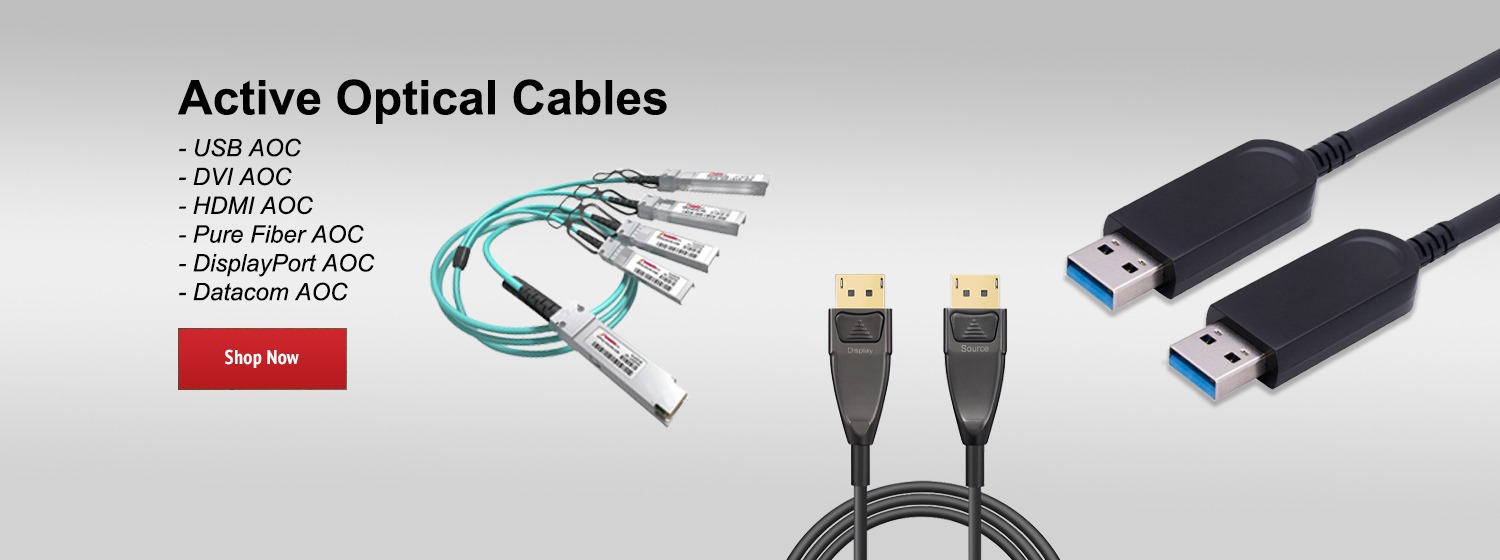
USB Active Optical Cables (AOCs) are a specialized type of USB cable that utilizes optical fiber to transmit data, offering significant advantages over traditional copper USB cables, especially for long-distance connections.
Here's a breakdown of USB AOC cables:
1. How They Work:
- Hybrid Design: USB AOCs combine optical fiber for data transmission with copper wires to provide power to the connected device and the active electronics within the cable.
- Signal Conversion: The cable incorporates tiny transceivers at each end that convert electrical USB signals into optical signals for transmission over the fiber, and then back to electrical signals at the receiving end.
2. Advantages of USB AOC Cables:
- Longer Distances: AOCs can transmit data over significantly longer distances than copper USB cables without signal degradation. They can reach lengths of 10 meters (33 feet) and beyond, whereas standard copper cables have a limited range, typically around 2 meters (6.5 feet) for USB-C.
- High Data Speeds: AOCs can support high-bandwidth data transmission, making them ideal for applications like high-resolution video (e.g., 4K, 8K), fast data transfers, and demanding peripherals.
- Reduced Interference: Fiber optic cables are immune to electromagnetic interference (EMI), which can disrupt data transmission in copper cables, especially over long distances. This makes AOCs suitable for use in electrically noisy environments.
- Improved Durability and Flexibility: AOCs are often thinner and more flexible than comparable copper cables and can be more resistant to bending or twisting damage.
3. Disadvantages of USB AOC Cables:
- Higher Cost: AOCs are generally more expensive than standard copper USB cables due to the specialized components and manufacturing processes involved.
- Directionality: Some AOCs may be directional, meaning they need to be plugged in with the correct end connected to the source and the device.
4. Applications of USB AOC Cables:
- High-Performance AV Setups: Connecting 4K or 8K cameras, displays, and other devices over long distances.
- Data Centers: Connecting servers and storage devices.
- Industrial and Medical Imaging: Extending the reach of USB cameras for industrial inspection and medical imaging.
- Surveillance and Security Systems: Connecting remote USB cameras for surveillance applications.
- Virtual Reality: Providing high-bandwidth connections for VR headsets.
5. Types of USB AOC Cables:
- USB 3.2 Gen 2: Supports data transfer speeds up to 10 Gbps.
- USB4: The latest generation of USB, supporting higher data transfer speeds.
- Different Connector Types: Available with various USB connector types, including USB-A, USB-B, USB-C, Micro-B, and Mini-B, to suit different devices and applications.
In summary, USB AOC cables are a valuable solution for applications requiring high-speed data transmission over long distances and in environments prone to electromagnetic interference. While they are more expensive than traditional copper cables, their performance advantages make them a worthwhile investment in demanding professional settings.
Buy USB AOC Cables at compufox.com
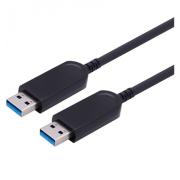
 USB AOC AM to AM USB AOC AM to AM |
| USB AOC AM to AF |
| USB AOC AM to BM |
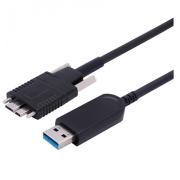
| USB AOC AM to Micro-B |
| USB AOC AM to Type-C |
| USB AOC Type C-C |
| USB HUB for USB AOC |